
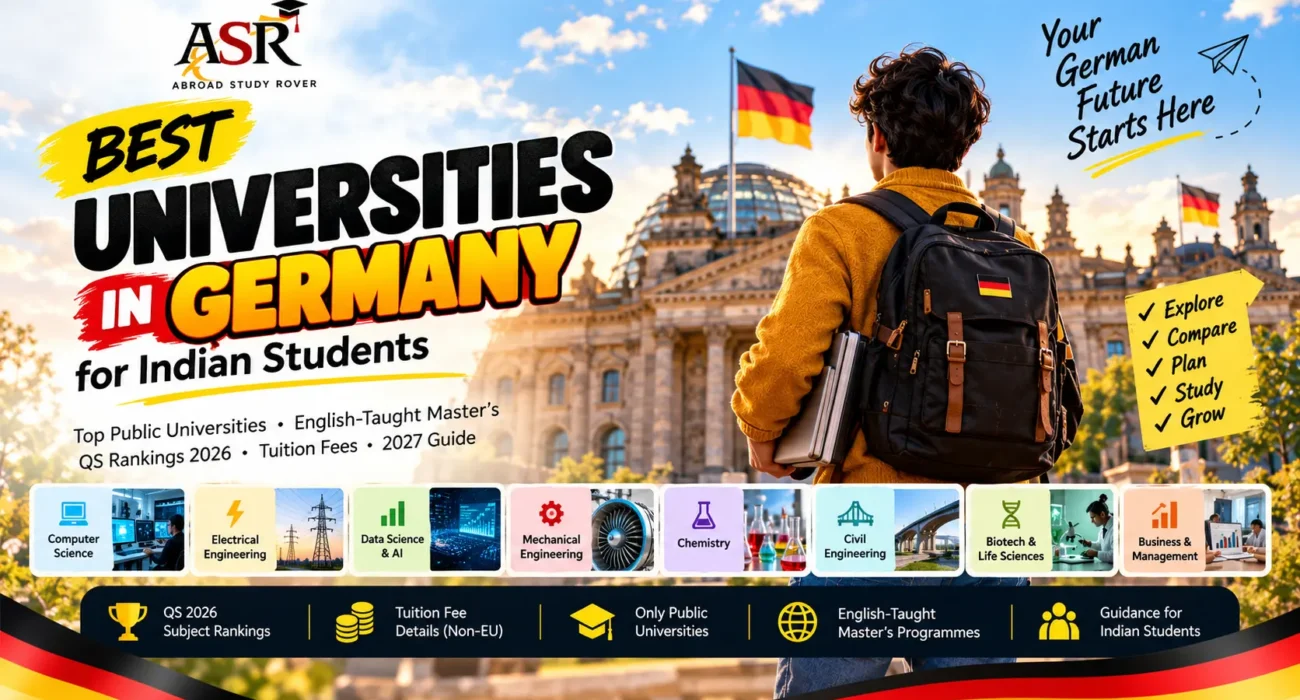
Best Universities in Germany 2027: The Complete Guide by Field of Study
Every student who calls us asks some version of the same question: “which are the best universities in Germany 2027 for my field?” It’s a fair question, and a hard one to answer with one list, because the right university for a Mechanical Engineering student looks nothing like the right one for someone chasing an MBA. This guide breaks it down properly field by field, with real tuition numbers and QS 2026 ranking order so you’re shortlisting based on your subject, not just a generic “top 10” that doesn’t actually apply to you.
How We Picked the Best Universities in Germany 2027
Every university below is ranked using QS 2026 order within its field, and we’ve pulled in actual tuition figures so you can see the real cost picture because top universities in Germany lists that skip tuition are only telling you half the story. A lot of what looks like Germany’s biggest advantage (public, tuition-free education) only applies to some universities and some states not all of them.
Best Universities in Germany for Engineering
Germany built its reputation on engineering, and it still shows. Depending on your specialization, different universities pull ahead:
Mechanical Engineering: TU Munich leads with its Aerospace program (€6,000–€6,800/semester), followed by KIT Karlsruhe’s Mechanical Engineering track (€1,500/semester) and RWTH Aachen’s Automotive Engineering program, which carries no tuition at all. University of Stuttgart’s FAME program and TU Berlin’s Global Production Engineering round out the field.
Civil Engineering: TU Munich’s Computational Mechanics (€6,800/year) tops the list, but RWTH Aachen (Transport Engineering and Mobility), TU Berlin (Civil Systems Engineering), and TU Dresden (ACCESS — Computational Civil Engineering) all offer the same QS-ranked quality with zero tuition.
Electrical Engineering: TU Munich’s Communications and Electronics Engineering program runs €6,800/year, while RWTH Aachen and TU Dresden offer equally strong, tuition-free Electrical Engineering and IT tracks. FAU Erlangen is a solid mid-range option at €2,000/year.
Why Engineering Pulls So Many International Students to Germany
It’s not just the rankings — it’s the direct pipeline into companies like Siemens, Bosch, and BMW that recruit straight from these programs.
Best Universities in Germany for Business & Management
If you’re chasing an MBA or Master’s in Management, four names come up constantly among the best universities in Germany for masters in business:
- TU Munich — Management and Technology, €4,600/year
- University of Mannheim — Mannheim Master in Management, €1,500/year
- LMU Munich — Management and Digital Technologies, no tuition
- University of Cologne — Business Administration and Corporate Development, no tuition
For students specifically hunting an MBA in Germany public university option, Mannheim and Cologne are the two names worth starting with — both carry strong rankings without the private-business-school price tag.
Best Universities in Germany for Computer Science & Data Science/AI
Tech is where Germany is growing fastest, and it shows in how many tuition-free options now sit at the top of the rankings:
- TU Munich — Informatics, €6,000–€6,800/year
- TU Berlin — Computer Science, no tuition
- KIT Karlsruhe — Computer Science, €1,500/year
- RWTH Aachen — Software Systems Engineering, no tuition
- TU Darmstadt — Computer Science, no tuition
For Data Science and AI specifically, LMU Munich (Statistics and Data Science), University of Tübingen (Machine Learning, €1,500/year), and TU Darmstadt (AI and Machine Learning, no tuition) are the strongest picks right now — Berlin’s startup ecosystem makes it an especially good launchpad after graduation.
Best Universities in Germany for Biotech, Life Sciences & Chemistry
This is a quieter cluster, but it consistently produces some of the lowest tuition numbers on this whole list:
- University of Heidelberg — Molecular Biosciences, €1,500/year
- University of Tübingen — Cellular and Immunological Biosciences, €1,500/year
- LMU Munich — Molecular Life Sciences / Biochemistry, no tuition
- University of Göttingen — Molecular Life Sciences, no tuition
- RWTH Aachen — Sustainable Chemistry, no tuition
- TU Munich — Chemical Biotechnology, €4,000–€4,600/year
Public Universities in Germany for Masters — Where Tuition Is Free
Here’s the pattern worth noticing across every field above: RWTH Aachen, LMU Munich, TU Berlin, TU Dresden, Göttingen, and TU Darmstadt show up again and again as no-tuition options. If minimizing cost is your top priority, these six names should anchor your shortlist regardless of which subject you’re applying for — they’re genuinely among the public universities in Germany for masters worth prioritizing first.
Best Universities in Germany for International Students — What Actually Matters
Rankings matter, but they’re not the only filter. When you’re evaluating the best universities in Germany for international students, also check:
- Language of instruction — many of these programs are English-taught, but some (especially in Chemistry and Engineering) still require German proficiency
- APS certificate requirements — mandatory for most Indian applicants; see our [APS Certificate for Germany 2026] guide
- Application deadlines by intake — some programs only admit in winter; see our [Summer Intake for Germany 2027] guide if you’re planning an April start
- Real cost of living, which varies hugely by city — our [Cost of Living in Germany for Students] guide breaks this down
Best Universities in Germany for MS — A Quick Shortlist by Budget
If you’re specifically comparing options for an MS, here’s a fast way to sort the best universities in Germany for ms by what you’ll actually pay:
- Free tuition: RWTH Aachen, LMU Munich, TU Berlin, TU Dresden, Göttingen, TU Darmstadt
- Low tuition (€1,500/year): KIT Karlsruhe, University of Mannheim, University of Heidelberg, University of Tübingen, University of Stuttgart
- Premium tuition (€4,000–€6,800/year): TU Munich (across almost every field), FAU Erlangen
Frequently Asked Questions
1. Which are the best universities in Germany overall?
It depends entirely on your field TU Munich, RWTH Aachen, LMU Munich, KIT Karlsruhe, and TU Berlin consistently rank at or near the top across Engineering, Computer Science, Business, and Life Sciences in QS 2026.
2: Which public universities in Germany offer free tuition for a Master’s?
RWTH Aachen, LMU Munich, TU Berlin, TU Dresden, University of Göttingen, and TU Darmstadt all offer tuition-free Master’s programs across multiple fields.
3: What’s the best public university in Germany for an MBA?
University of Mannheim and University of Cologne are the top public-university picks for management-focused Master’s and MBA-style programs.
4: Are the best universities in Germany for international students the same as for local students?
Mostly yes — rankings don’t change by nationality, but international students should additionally check APS requirements, language of instruction, and intake deadlines before applying.
5: How much does tuition cost at top universities in Germany for masters?
It ranges from completely free (at public universities like RWTH Aachen and TU Berlin) to €6,000–€6,800/year at TU Munich, depending on the program and specialization.
Not Sure Which of These Fits Your Profile?
Rankings are a starting point, not the whole decision the right university depends on your grades, your budget, and the specific specialization you want. At Abroad Study Rover, Germany Education Consultancy in Hyderabad, we run a free profile check against this exact shortlist and tell you honestly where you have the strongest shot.