
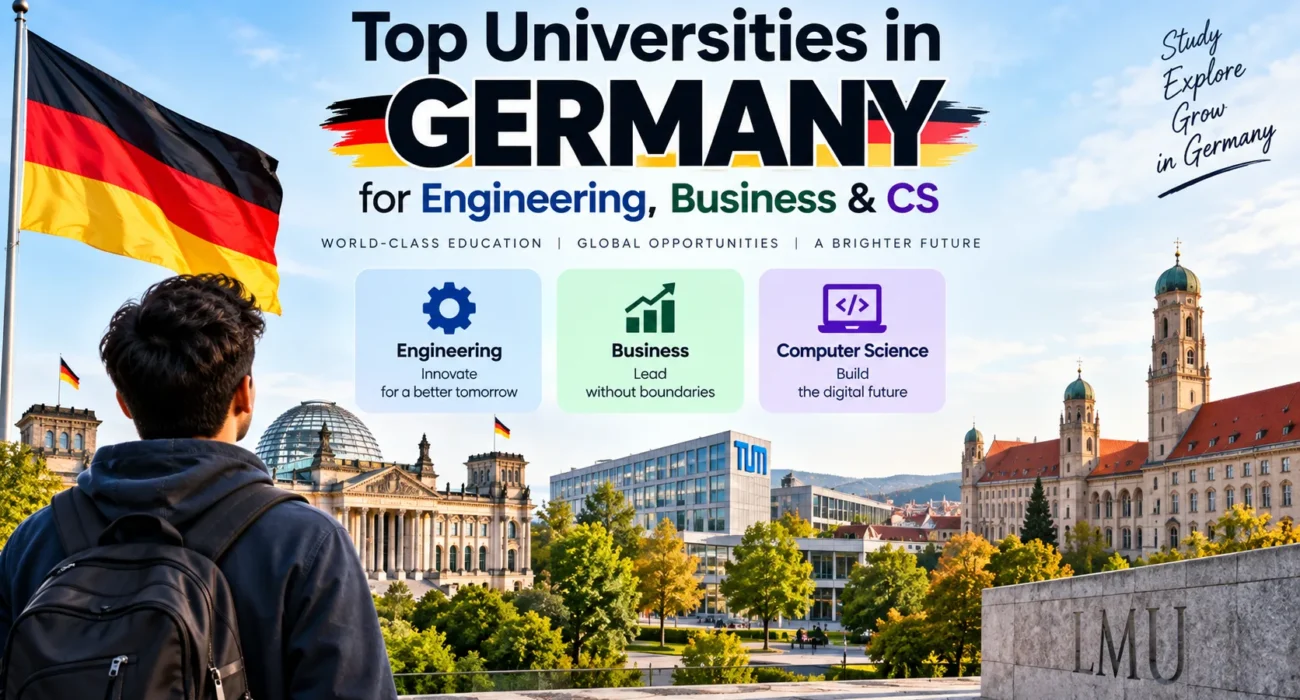
Top Universities in Germany for Engineering, Business, and Computer Science Students (2026 Guide)
Germany is one of the most sought-after destinations for international students, and it’s easy to see why. With tuition-free public universities, globally respected degrees, and direct access to Europe’s largest economy, Germany consistently ranks among the top study-abroad choices especially for students pursuing Engineering, Business, and Computer Science.
In this guide, we break down the best German universities by field, so you can shortlist the right ones based on rankings, tuition, and career outcomes. If you’re just starting your research, check out our Complete Guide to Studying in Germany for International Students for visa, cost, and application basics before diving into university-specific details.

Why Germany Is a Top Choice for Engineering, Business & CS Students
Germany’s higher education system is built around applied research and strong industry connections home to companies like Siemens, BMW, SAP, and Bosch, which regularly recruit directly from local universities. Nearly 20 German universities rank in the global top 200, and the country’s public universities charge little to no tuition fees, even for international students, making it one of the most affordable high-quality education systems in the world.
Key advantages include:
- Low or no tuition fees at public universities (only a small semester administrative fee)
- Strong industry-academia links, especially in engineering and applied sciences
- English-taught master’s programs in most technical and business fields
- Post-study work visa of up to 18 months to find a job after graduation
- Global recognition of German engineering and technical degrees
Top Universities in Germany for Engineering
Germany’s engineering programs are considered among the best in the world, with a strong focus on precision, research, and hands-on industry projects.
University
Technical University of Munich (TUM)
19
Technische Universität Berlin (TU Berlin)
45
Karlsruhe Institute of Technology (KIT)
53
RWTH Aachen University
65
Technische Universität Dresden
97
Universität Stuttgart
182
Technical University of Darmstadt
187
Popular Engineering Specializations in Germany
- Mechanical Engineering
- Automotive Engineering
- Electrical & Electronics Engineering
- Robotics and Automation
- Renewable Energy Engineering
TUM Munich and RWTH Aachen are particularly known for automotive and mechanical engineering, thanks to their proximity to Germany’s automobile manufacturing hubs.
Why Study Business in Germany?
Germany is home to Europe’s largest economy and headquarters of major multinational companies. Studying an MBA here means direct access to internships and networking opportunities in consulting, finance, and technology sectors, at a fraction of the cost of comparable programs in the US or UK.
Top Universities in Germany for Business & MBA
Germany’s business schools are gaining global recognition for offering industry-focused, affordable MBA and management programs compared to the US or UK.
Top choices for business and management studies include:
- Mannheim Business School – Consistently ranked #1 in Germany for MBA and management programs
- HHL Leipzig Graduate School of Management – Strong in entrepreneurship and finance
- ESMT Berlin – Known for its international faculty and corporate partnerships
- Frankfurt School of Finance & Management – Ideal for finance and banking careers
- WHU – Otto Beisheim School of Management – Highly ranked for its MBA and CEMS Master’s program
Top Universities in Germany for Computer Science
With Germany’s tech industry growing rapidly (Berlin is often called the “Silicon Valley of Europe”), Computer Science has become one of the most in-demand programs for international students.
- Technical University of Munich (TUM) – Top-ranked for CS and AI research in Germany
- RWTH Aachen University – Strong focus on software engineering and data science
- Karlsruhe Institute of Technology (KIT) – Known for cybersecurity and computer engineering
- Technische Universität Berlin (TU Berlin) – Great for CS with strong startup ecosystem access
- Ludwig-Maximilians-Universität München (LMU Munich) – Excellent for theoretical computer science and AI
Popular CS Specializations
- Artificial Intelligence & Machine Learning
- Data Science & Analytics
- Cybersecurity
- Software Engineering
- Embedded Systems
Tuition Fees & Admission Requirements Overview
Program Type
Public University Tuition
Typical Requirements
Bachelor’s (Engineering/CS)
Free – ~€150 semester fee
High school diploma, German/English proficiency
Master’s (Engineering/CS)
Free – ~€150–350 semester fee
Bachelor’s degree, GRE (sometimes), IELTS/TOEFL
MBA (Private B-Schools)
€20,000–€45,000 total
Bachelor’s degree, GMAT/GRE, work experience (2+ years)
For a detailed breakdown of visa requirements, blocked account rules, and document checklists, see our Germany Student Visa Process Guide.
How to Choose the Right University for You
- Program language – English-taught vs. German-taught (German proficiency may be required for some technical programs)
- Location & industry access – Munich and Stuttgart for automotive/engineering; Berlin and Frankfurt for business and tech
- Public vs. private – Public universities are nearly free; private business schools charge tuition but offer smaller class sizes and strong placement support
- Research vs. applied focus – Universities (Universität) lean research-heavy; Universities of Applied Sciences (Fachhochschule) are more industry/practice-oriented
To understand this distinction in more depth, read our post on Public vs Private Universities in Germany.
Frequently Asked Questions
1.Which German university is best for engineering?
The Technical University of Munich (TUM) is widely regarded as Germany’s top engineering university, ranked 19th globally in QS Engineering Rankings 2025.
2. Is an MBA in Germany worth it?
Yes — German MBA programs like Mannheim and ESMT Berlin offer strong ROI due to lower tuition costs and access to Europe’s largest job market.
3. Do I need to know German to study Computer Science in Germany?
Not necessarily. Most master’s programs in CS and Engineering are offered in English, though learning basic German helps with part-time jobs and daily life.
4. Are public universities in Germany really free for international students?
Yes, most public universities charge no tuition fees, only a small semester contribution (typically €150–€350) that often includes a public transport pass.