
- contact@abroadstudyrover.com
- +91 6300843102
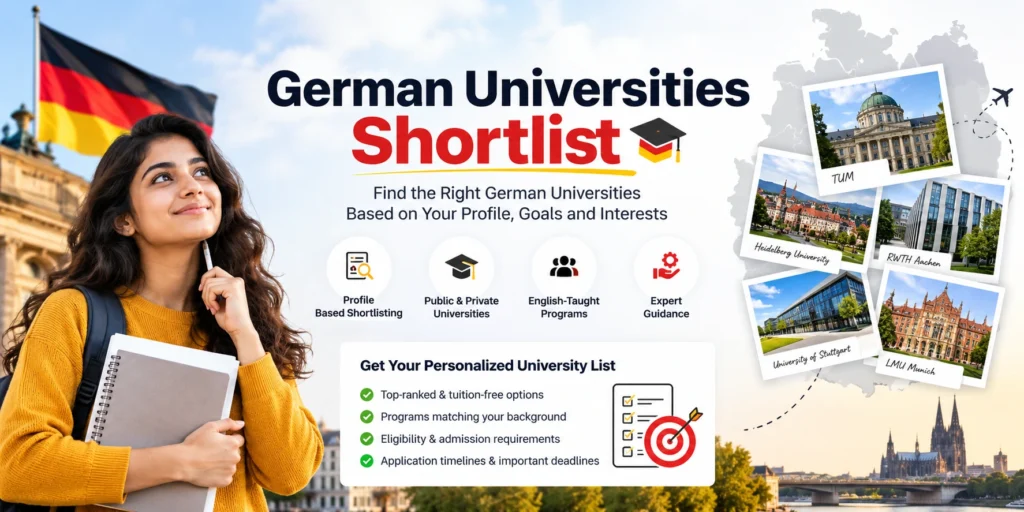
Building your German universities shortlist is the most important decision you’ll make before you apply. Get it right and you land a course that fits your grades, your budget and your career plans. Get it wrong and you lose months to rejections, missed deadlines and fees nobody warned you about.
This guide walks Indian students through the whole process, step by step: choosing a course, comparing public and private universities, and balancing ambitious picks with realistic ones. Applying for the Summer or Winter 2027 intake? Start here, then let our Hyderabad counsellors check your list for free.
Germany has hundreds of universities and thousands of degree programmes. The hard part isn’t finding options, it’s narrowing them down. A focused list of six to eight universities helps you:
– Match your academic profile with realistic admission requirements
– Stay within budget, including rent, food and insurance
– Track deadlines that change from one university to the next
– Apply to a balanced mix, so one rejection doesn’t derail your plan
Think of your shortlist as an application strategy, not just a list of names.
Most students begin with a university name. Begin with the course instead. A university can be brilliant for engineering and average for marketing, and admission rules change from programme to programme. Here’s how the three most popular routes look for Indian applicants.
A bachelor degree in Germany for international students usually takes three to four years. Public universities teach most bachelor’s programmes in German, so English-taught options are mostly found at private universities and a limited number of international programmes. Indian students with a 12th-grade certificate often need a Studienkolleg (foundation year) before entering a public university, though rules vary by university, so confirm before you add anything to your list. Private options such as [SRH University Hamburg] offer English-taught bachelor’s tracks in selected fields, usually with more direct entry and higher fees.
A master degree in Germany for international students is the most popular route for Indian applicants, thanks to the large number of English-taught programmes in engineering, computer science, data science and management. Public universities such as [LMU Munich] charge no tuition for most standard programmes, but they look closely at your grades, subject match and degree length. Our [MS in Germany guide]
Business courses in Germany for international students range from MBA and MSc Management to International Business, Finance and Marketing. Public options exist, yet many Indian students choose private business schools for English-taught delivery and industry-linked teaching. Compare [GISMA University], [ICN Business School] and [PFH University] to see how fees, campus locations and teaching styles differ.
Follow these seven steps in order. Each one removes options that don’t fit, so your final list stays short and realistic.
Budget decides how wide your list can be. Most public universities charge only a semester contribution of a few hundred euros, while private universities typically charge anywhere from about €8,000 to €16,000 or more per year. One exception: public universities in Baden-Württemberg (home to Stuttgart, Heidelberg and Karlsruhe) charge non-EU students around €1,500 per semester.
|
City Type
|
Example Cities
|
Approx. Monthly Living Cost
|
|---|---|---|
These are estimates covering rent, food, transport and insurance. Rents change quickly, so check current figures before you commit.
Convert your marks with our free [German grade calculator] to see where you stand, then compare the result with each programme’s requirements. Check three things: minimum grade, subject match and degree length. Indian applicants also need an [APS certificate] for public universities, so start that process early.
|
Factor
|
Private Universities
|
Public Universities
|
|---|---|---|
|
Tuition
|
Mostly free (semester fee only)
|
Roughly €8,000 – €16,000+ per year
|
|
Admission
|
Competitive, grade and subject driven
|
More flexible, faster decisions
|
|
Teaching language
|
Many programmes in German, growing English Master's options
|
Mostly English-taught
|
|
Class size
|
Larger
|
Smaller, more mentoring
|
|
Best for
|
Research, engineering, tight budgets
|
Business, flexible entry, student support
|
Neither is better. The right choice depends on your budget and how much admission flexibility you need.
English-taught programmes usually ask for IELTS 6.0–6.5 or an equivalent TOEFL score. German-taught programmes need DSH, TestDaF or a Goethe certificate. Book your test early, because many universities want the score at application stage.
Germany has two main intakes: Winter (starting around October) and Summer (starting around April). Deadlines vary widely, and competitive Master’s programmes often close months before the semester begins. Applications routed through [uni-assist] can add processing time. For 2027 entry, start your documents at least three to four months before the earliest deadline on your list.
Your city shapes your part-time work, internships and job search. Munich and Stuttgart are strong for engineering and automotive roles, Berlin for startups and tech, Frankfurt for finance, and Hamburg for logistics and trade. Match your course to the local industry, and remember the 18-month post-study job-search visa gives you time to turn that network into a job.
The strongest German universities shortlist mixes risk levels: two or three ambitious picks, two or three target picks that closely match your profile, and two flexible-entry options as a safety net. Six to eight applications in total is a sensible range.
Here’s how a balanced list could look, using universities we already cover on our site. It’s an example, not a recommendation. Your own list depends on your profile, course and budget.
|
Category
|
University
|
Known For
|
|---|---|---|
|
Ambitious (public)
|
[LMU Munich]
|
Research-led programmes in sciences and humanities
|
|
Balanced (private)
|
[PFH University]
|
|
|
Flexible entry (private)
|
English-taught business and tech programmes
|
|
|
Flexible entry (private)
|
Management and business programmes
|
|
|
UK degree option
|
A UK-awarded degree at a German campus
|
– Academic transcripts and degree certificates
– APS certificate
– IELTS or TOEFL score (or German language certificate)
– Statement of Purpose (SOP)
– Two letters of recommendation
– Updated CV
– Valid passport
Having these ready means you can apply the day your list is final.
– Choosing by ranking alone and ignoring subject fit
– Applying only to top-tier universities
– Ignoring uni-assist processing time
– Underestimating living costs in expensive cities
– Relying on last year’s deadlines
– Skipping official sources like [DAAD] and [Hochschulkompass](https://www.hochschulkompass.de/en/) when verifying programme details
Still unsure which courses in Germany for international students suit your profile? Our Germany counsellors in Hyderabad compare your grades, budget and goals against hundreds of programmes, then send you a ready-to-apply shortlist. It’s free.
Six to eight is a practical range. Include two or three ambitious options, two or three that closely match your profile, and two with flexible entry, so a single rejection doesn’t leave you without options.
Start with the course, then check minimum grade, subject match, degree length, language score and deadline for each programme. Add only programmes that pass every check to your German universities shortlist, and verify details on official portals like DAAD.
Yes, but your options are narrower. Most public bachelor’s programmes are taught in German, so English-taught bachelor’s degrees are mainly found at private universities and a few international programmes. Many Indian students also need a Studienkolleg first.
Popular choices include MBA, MSc Management, International Business, Finance, Marketing and Business Analytics. The best fit depends on your work experience, budget and career goals, so compare fees, curriculum and internship links before you decide.
Engineering, computer science, data science and management programmes attract the most Indian applicants because of strong English-taught options and good job prospects. High-demand fields are also more competitive, so shortlist carefully.
Ideally six to nine months before your intake. That gives you time to convert your grades, take your language test, complete your APS certificate and prepare your SOP and recommendation letters before the first deadline.
WhatsApp us